On Long COVID
I’ve been meaning to write something about long COVID for a while since I’m directly affected, but it’s difficult to summon the energy. I partly want to write this just so I’ve got a record of it. Long COVID is tumultuous and confounding. Sometimes you doubt yourself.
Before I start, here’s an amazingly on-the-money primer on how Chronic Fatigue Syndrome (CFS) is often (mis)perceived by the general public (The Armando Iannucci Shows is a largely forgotten gem):
I should also mention that long COVID encompasses multiple phenotypes. By this, researchers find there are common sub-groups of long COVID patients who have one or more symptom clusters (e.g. Fatigue, Cardiovascular, Neurological).
The CFS ‘phenotype’ of long COVID closely tracks with CFS itself. Sufferers are often misunderstood or forgotten.
Deaths are down, but COVID-19 is not “over”
The world’s collective leadership seems to be pretending that COVID is over, and we’ve all moved on.
Firstly, I will acknowledge that COVID is now endemic and no longer represents a major risk to the average person in terms of deaths and hospitalisations. The figures don’t lie in that respect.
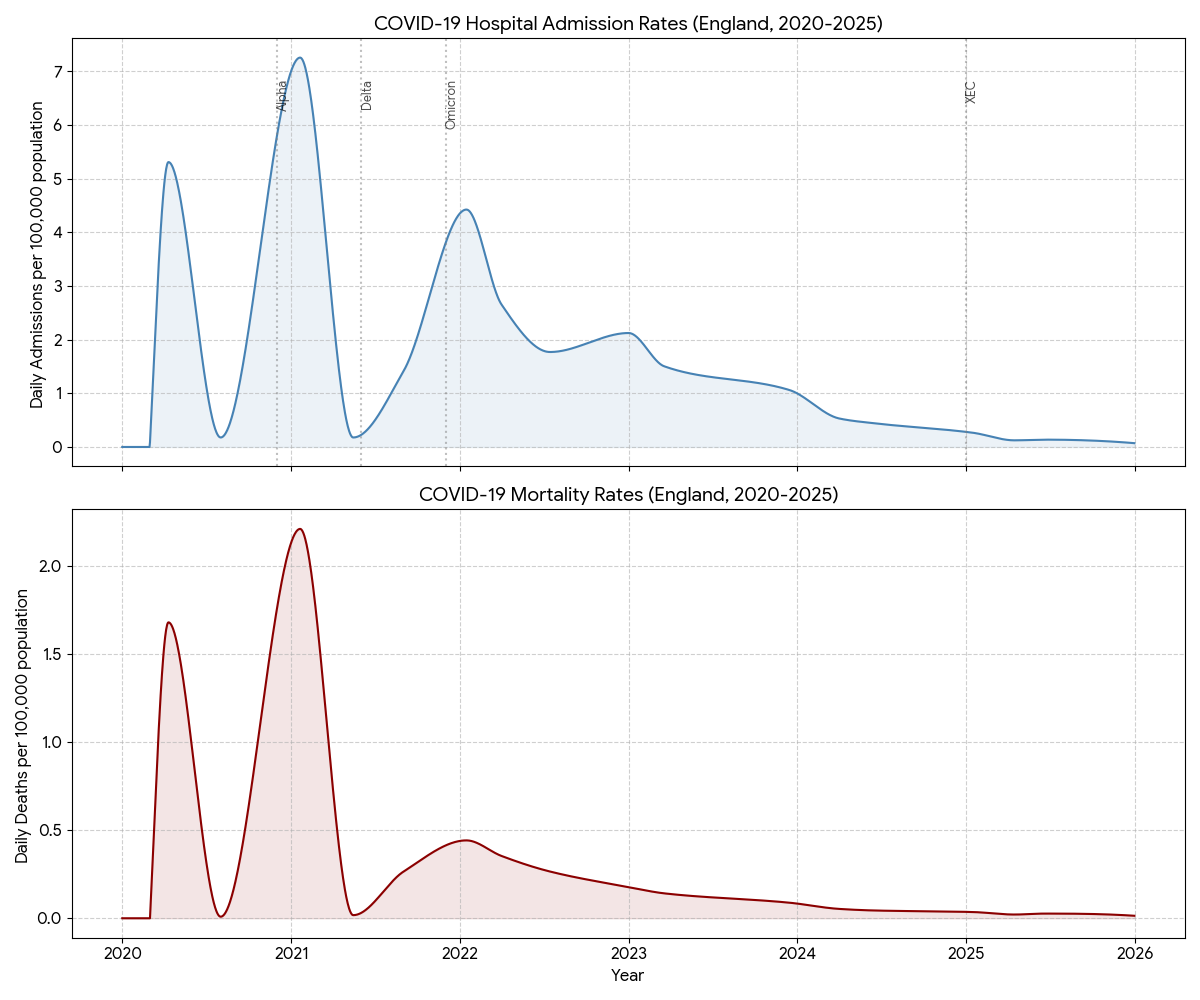
There are several reasons for the drops in death rates:
- Many at-risk/infirm people died early in the pandemic, and cannot die again (pithy, but you get the gist – I still miss John Prine and many other folks who we sadly lost)
- Rapidly improved treatment protocols for high-risk patients (e.g. drugs like Dexamethasone and IL-6 Inhibitors, antivirals like Paxlovid etc.)
- From mid-2021 onwards, vaccinations protect against hospitalisation and death (look at that Omicron wave in 2022 compared to 2020!)
- Prior COVID infections also protect against hospitalisation and death
Aside: Most people (falsely!) believe the Omicron variant of COVID was significantly less deadly compared to the original variant, but this is a misconception. Omicron was highly transmissible (it spread freely) and was just as severe as the original variant of COVID; it just didn’t feel like it because:
- The Delta variant was much nastier
- The population was benefitting from (I sound like a COVID estate agent, sorry) some of the things I’d previously mentioned.
It’s not all good news, though. We also know that, amongst other things:
- Each successive COVID infection has a chance of causing long COVID
- All-cause mortality increases for a prolonged period after a person is infected with COVID
- COVID infections cause a reduction of grey matter in the brain
We also know that so-called “long haulers” are in the millions in most countries. While most recover inside a year, many do not.
My problems with long COVID
I’ve been infected with COVID twice, and both infections resulted in long COVID with a range of symptoms.
Infection one: April 2020
I would’ve been 37 at the time. I weighed around 89 kg (196 lbs) at 6’6 (198 cm). I was pretty fit and strong, could hit a 30 kg weighted pull-up and a 50 kg weighted dip – hardly record-breaking stuff, but good going for me. Around that time, I ran 3 half-marathons in successive weeks for fun. This is all to say, I was fitter than the average Joe. While I’m sure being fit and healthy helped, it did not stop COVID doing a number on me.
I was well-briefed on COVID and was generally pretty careful. I prioritised ventilation, stopped taking public transport & taxis and generally played it safe. I thought the gym was relatively safe, as it was quiet and the big door(tm) at the front was open. This was hubris – I should’ve been even more cautious.
Looking back, we didn’t know a great deal about COVID. The major broadcasters in the UK weren’t mentioning that losing your sense of taste and smell was a symptom. This was a new experience for me, so I did a bit of digging on the web and decided to self-isolate for two weeks. I’m glad I did because I was due to visit my family.
The bout of COVID itself was a non-event. It felt no worse than a cold, plus the aforementioned loss of taste and smell. I was back doing home gym stuff and running immediately afterwards with seemingly no ill effects. Easy.
Long COVID one
A few weeks or perhaps a month later (I didn’t keep a diary, sadly), things took an unexpected turn: I was struck down by crippling fatigue. The exhaustion was so all-encompassing that I didn’t even register the headache – the two were entwined, inseparable and crushing.
The only way I can explain the feeling is that you’re a toddler that’s run a marathon, you’ve got the raging abdabs and you’re basically crabby as fuck – you will fall asleep at the drop of a hat. 50% of your cells are already asleep. 25% are in that dozing phase (where deep sleepers are nominally awake, but can have conversations they don’t remember) and the final 25% are technically awake, but in power saving mode and soon to shut down.
There was no known thing called “Long COVID” back then, so I was confused and perturbed in equal measure. My former flatmate had suffered from a prolonged bout of post-viral fatigue after contracting glandular fever, and that was the only thing I could think of that was comparable.
I would clamber out of bed in the mornings and ‘go’ to work (part-time, remote working as a software engineer), but found I couldn’t stay awake long enough to be productive. I was supposed to work two days a week as a temporary gig, but had to split my two days of work into four or five smaller sessions. Even two hours a day was a challenge – it took an age to complete simple tasks. I’d often wake up, ‘work’ for an hour, and then go back to bed, defeated.
Bed is good when you’re ill though, right? In a cruel twist of fate, bed was arguably worse. When lying down, there was a sensation of pressure on my chest. My upper chest ached. The moment I drifted off, I would wake up feeling like I’d not taken a breath for minutes. I didn’t know it at the time, but the symptoms were possibly pericarditis (inflammation of the heart lining) – more on this later.
Anyway, this went on for weeks, and then months. I don’t know how long exactly because, again, I didn’t keep a symptom diary. I saw the GP multiple times in June, so it likely tailed off after that and I recovered.
Recovery one
The problem with COVID, as we were beginning to find out, is that it’s not a simple respiratory virus. While most people shrug it off, a minority do not.
COVID makes it its business to get into everything. Lungs? Sure. But how about heart, stomach, bowels, brain and the works? It gets into your blood. It even trips up your vascular system.
I felt largely fine by day, but as the months dragged on I still had bouts of intermittent chest pressure/pain and woke up minutes after falling asleep, gasping. I’ve always been a deep sleeper and a non-worrier. I hit the pillow and it’s lights-out, so it was annoying.
Anyway, I noticed something new: heart palpitations. Several times a day, apropos of nothing, my heart would add extra beats. The sensation was very unpleasant: it was like being thumped in the chest. Each time, I’d wait to see if it’d keep on beating. “Unpleasant, but likely benign”, was my self-diagnosis and the GP wasn’t concerned – they had a lot of ground to cover.
I returned to exercise. I ran, I lifted weights. But when I raised my heart-rate, I noticed the palpitations increased in frequency. Exercise was now tied to negative physical effects.
This went on for years, and I finally got a 24 hour heart monitor in 2023 that allowed a cardiologist to diagnose me with intermittent first-degree heart block (along with a bunch of other scary-sounding but ultimately benign conditions). COVID likely was to blame.
As I previously mentioned, myocardial infarctions (heart attacks) occur at an elevated rate in people who’ve recently had COVID. I didn’t have a heart attack, but it’s yet another thing that COVID can cause, and it shows up in every country’s catch-all excess mortality figures.
Life from 2021-2024
A lot happened in this period. I quit eeGeo (aka WRLD) – a company that I’d worked for from 2010-2022 – and joined Infinity Works as a senior consultant. This meant travel and in-person working was back on the cards.
After my first bout with long COVID, I took precautions:
- I insisted on eating and drinking outside (weather permitting!)
- I got all of my COVID vaccinations/boosters
- I purchased a large supply of N99/FFP3 face masks and wore them when shopping, using public transport, visiting the doctor and for other things I saw as ‘utilitarian’
- I bought an Aranet4 air quality meter to gauge risk when at work and in unfamiliar client offices (highly recommended).
I got some funny looks. As of early 2022 COVID was deemed ‘over’ and a chunk of the population viewed masking as an unpleasant reminder that COVID still existed.
There’s a certain group who assume that because COVID didn’t harm them, being careful with masking / air quality to protect yourself is simply high theatre – a twatty affectation. The calculus changes after you’ve spent months being unable to stay awake, only to wake up, gasping, with an elephant on your chest.
Some nutter tried to remove my mask as I walked out of the shops and was summarily told to go fuck himself. He ranted at me, telling me that “people like me” were the reason his children were home from school. These are the toss-arses you see on Facebook confidently talking about “vaccine injury” because Bev from 3 doors down “definitely knows someone high up at the hospital”, and “it’s all a big cover-up, yeah?”
On the more mundane end of the spectrum, a few people in client offices made snarky remarks and treated me like I was crazy for wearing a mask in a crowded meeting room when the CO₂ hit 1200ppm and continued increasing. Someone said, “you know masks don’t work, right?”, as he thought my N99 mask was a cloth one or had no idea of the differences. No point arguing, though. In my experience, people get over it when you stick to your guns and quietly get on with it.
I didn’t wear a mask 24/7 mind, e.g. I didn’t mask in open-plan areas at work where CO₂ was at reasonable levels.
So anyway, I’d had some unpleasant months and my quality of life was slightly diminished after the heart debacle, but life goes on. Until…
Infection two: September 2024
Time flies. I was 41. I’m pretty sure I picked up the COVID infection on the train back from Edinburgh. I’d been on a whisky-tasting tour with a friend and succumbed to pint-mania after an excellent day out. At least I got infected doing something fun rather than buying reduced price fishcakes in Lidl.
On the train back, I broke my rule: I was half-cut and dozed off without putting on my mask. I was rudely woken 20 minutes later by a rude berk with a barking, hacking cough. They were clearly ill but travelled without a mask. I put on my mask and moved carriage but alas, too little, too late.
Unlike my first go around, this COVID infection was hellish. It was like proper flu. If you’ve ever had the proper flu (where you are bed-bound, sweating yet freezing, coughing to the point where your throat is raw and feeling like you’ve been swaddled in a sleeping bag and summarily beaten with hammers), you’ll know what I mean. It lasted two weeks.
Just as suddenly as it struck me down, the clouds cleared. I felt tired and weak after weeks of indolence and eating much of nothing, but not too bad considering.
This time around, I knew there were recommendations for e.g. athletes to take it easy after a COVID infection; I decided gentle walks would suffice, at least until I’d waited three weeks or so. Just as with my first COVID infection, there was a short period of good health afterwards.
Non-Recovery two
Some sequels are occasionally better than the original (The Dark Knight, The Bourne Ultimatum, arguably Terminator 2). This one was straight to DVD, starring a rotund and panting Steven Seagal.
Symptoms
Three to four weeks in, a creeping tiredness set in. I’d started doing some (very!) light jogging at lunchtime and figured I needed to shake off the rust. The round trip to my sandwich shop of choice is roughly 3.5k (around 2.2 miles). I decided to jog downhill and walk back.
Over the course of the week, crushing fatigue duly pressed me into the ground; each day got progressively harder. The chest pain returned. A headache joined the party and never left – my eyes feel like they’re too big for my skull, my sinuses hurt and there’s a band of pain across my forehead. Once again, the headache and the fatigue are usually entwined, one, all-consuming. Worse still, this time sleep was not refreshing – I’d open my eyes in the morning and feel as tired as the previous night. This made the fatigue relentless.
I’ve twice had my eyes tested at the optician to rule out eye-strain as a contributing factor. The dentist is pretty confident that my unerupted wisdom teeth are not causing referred pain, as such pain is rarely bilateral. A brain MRI came back showing that, yes, I have a brain and no, there’s nothing sinister on the scan. Last time I took my blood pressure, it was bang-on 120/60.
The annoying thing with long COVID is that many laboratory and diagnostic tests look normal. Doctors may doubt you (luckily, mine has been supportive). You may even doubt yourself at times. Sometimes I wonder if I just need to pull myself together, but a few hours or days later I am forcefully disavowed of those doubts as I struggle to decant myself from bed. We go round again.
Fatigue, Fatigue, Fatigue
Here’s where long COVID confounds you. Many people with long COVID can do things in the moment. But, like buying Big TV on tick or drinking 4 pints in an hour, you will pay for it down the line.
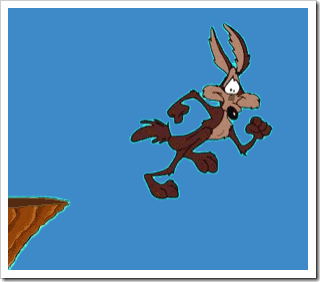
I liken this to Wile E. Coyote from The Road Runner: he runs out over the cliff and stands in thin air. Gravity is paused for a little while, but not long.
It’s also a bit like having a malfunctioning battery with no charge level shown. Sometimes the capacity is as expected. Other times, it is flat and you’re unknowingly running on fumes.
Each CFS sufferer has to mind their energy levels on multiple fronts, including:
- Physical activity (exercise, walking, standing upright, even sitting upright in bed etc.)
- Cognitive effort (thinking, working, writing – this blog post is depleting my reserves as I type)
- Social (meeting friends, speaking to people)
- General sensory stimulus (being in a loud place, bright lights, etc.)
The interplay between these aspects is unpredictable. Sometimes I’m fine, sometimes I do the same thing again and crash. Maybe things were different somehow? Maybe my energy levels were already depleted? Hard to say. As John Lydon once sang (before he started advertising butter), “Don’t ask me - ‘cause I don’t know”
Symptom Tracking
For stat and symptom tracking, I bought myself a cheap FitBit Inspire 3 (you can pick these up refurbished for cheap on eBay - around £30) in early 2025 and also track my HRV/pulse with the free Visible app. Combined, I can track things like:
- Sleep quality and duration (Awake, Light Sleep, REM Sleep, Deep Sleep)
- Resting Heart Rate (RHR)
- Heart Rate Variability (HRV)
I can recommend this combination because it can offer insight into your physical state – either warning you that something is off (RHR is high, HRV is low) when you’re unaware you should be taking it easy, or offering confirmation that yes, you are indeed feeling ‘off’. For example, I picked up a viral infection in January and …
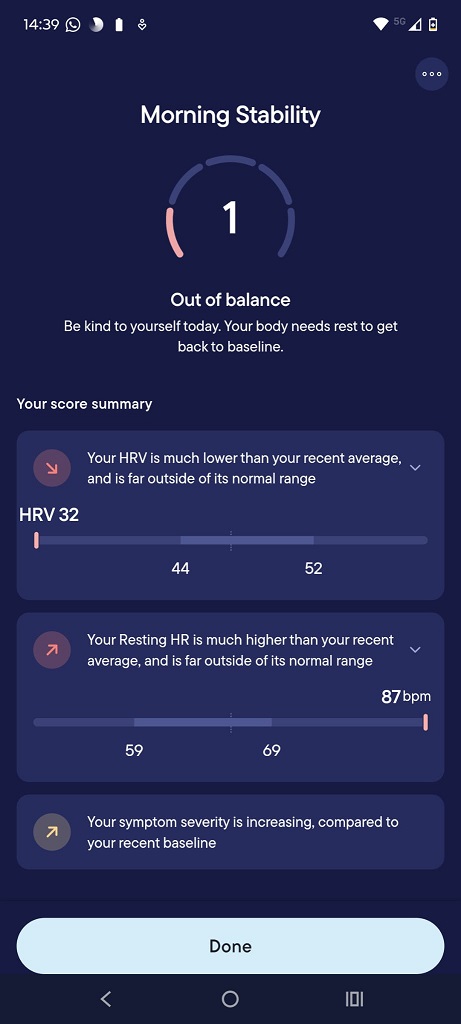
I have symptoms suggesting dysautonomia , too. Sometimes my heart will race when I stand or walk, but not always. I’ve had a heart-rate reading of 130 bpm after a quick shower. My heart-rate peaked at 158 bpm while walking up a hill a few weeks back. Sometimes gentle activity causes spikes. Other days it is normal. If you don’t track, you don’t know.
Quality of Life
Here’s a graph from the ME/CFS Wiki Page that tells a story (scroll down…):
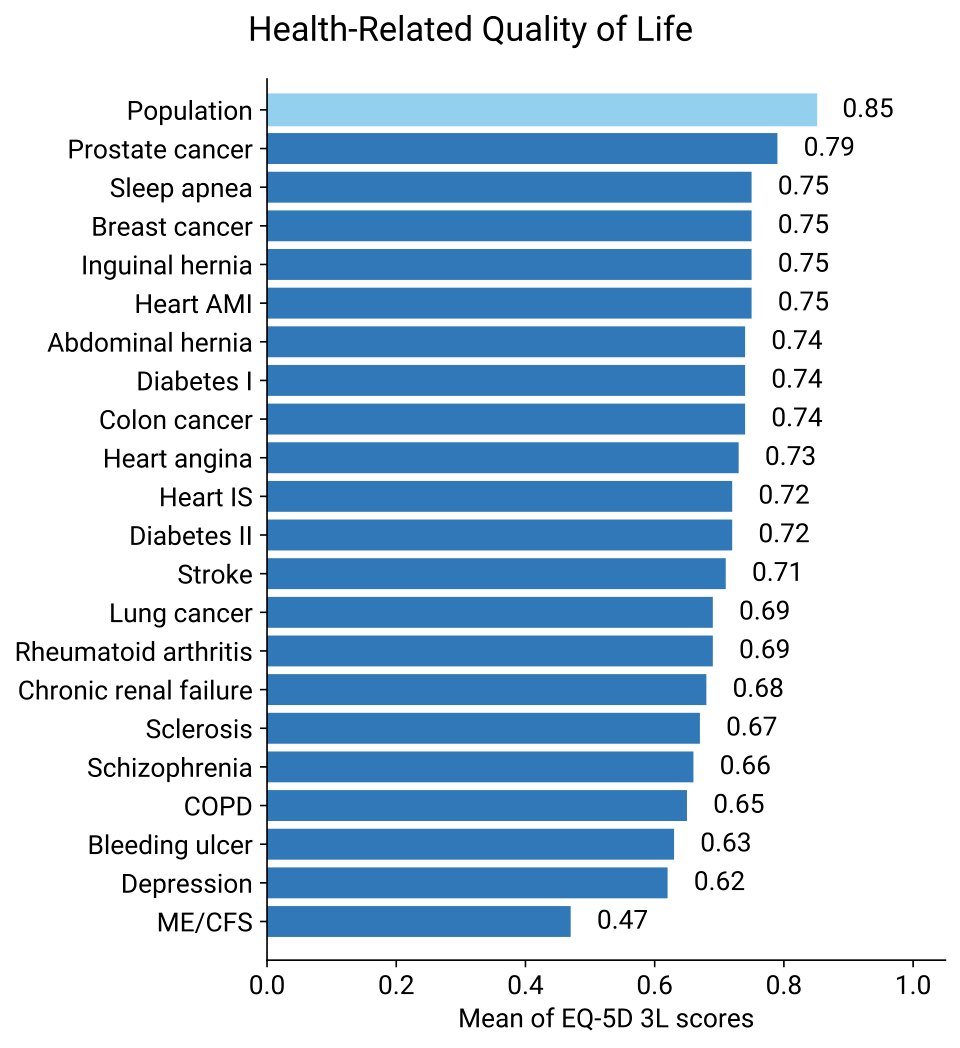
Misery is not a competition, but I want people to understand that dealing with chronic fatigue that permeates most areas of your life is generally a shite experience and I wouldn’t recommend it.
Everyone is affected differently. I’m lucky in that many basics I take for granted aren’t badly affected, e.g.:
- Cooking
- Reading for half an hour
- Passively watching TV
- Playing familiar games
- Walking slowly (I try to keep the distances short and my heart-rate low)
How people perceive CFS
Things can look normal to an observer. However, bear in mind that when you meet someone who has chronic fatigue or any hidden illness, you will likely be seeing them on a good day. If they were having a bad day, they’d be at home.
You do not see that person when they’re crashing, sleeping all hours and generally feeling terrible.
Some positives (for me, at least!)
Firstly, I’m quite lucky compared to some. Many long haulers cannot get out of bed for very long (or at all), hold a conversation, read a book or smell the literal or metaphorical roses. They exist and not much more.
Fatigue comes in self-moderating waves. It’s self-moderating because when you’re down, you can’t do much of anything. I’ve had good weeks where I felt upbeat for the future and dared dream of working up to a light jog. But I’ve also had many bad weeks where I spent 16 hour stretches in bed feeling wretched. I’m writing this after spending two such days in bed and feeling pretty pissed off about it.
I’m not a stoic by any means. I frequently feel pretty bad about the whole thing, but then I bounce back, Partridge-style. A-Ha! And write annoying blog posts. A-Ha!
Finally, I likely responded to some treatments – though it’s hard to say for sure, as sometimes you just get better by coincidence and the treatment had no effect.
Treatments
There’s a lot of experimental treatments flying about and this is a whole other post to make, but in short:
- Low-dose Naltrexone via Dickson Chemist
- For sleep and fatigue
- Amitriptyline (via NHS), Vitamin B2, 400 mg and Magnesium (370 mg from Lidl)
- For headaches – this is a fairly standard migraine medication stack
- I unfortunately had to get referred to a neurologist to access this
- G-NiiB (SIM01) Probiotics
- For fatigue. See this paper, but no idea if it does anything just yet
For general wellbeing and mildly reducing depression: (this is the useful version of stuff you see plastered on the back of a bus, asking, “Feeling Tired?”, except you’re not getting rinsed for a useless multi-vitamin):
- Vitamin D3 (4000 IU)
- Vitamin D3 is more easily absorbed by the body
- Omega-3
- The recommendation I read was to go for EPA at around ~60% of the Omega-3 total, and ~40% DHA.
- Take between 1,000 and 1,500 mg of Omega-3 per day (2 or 3 of those caps does the trick, but you may want to start with one cap and ramp up over time)
There are many potential and promising treatments, but this post is long enough as it is. The main thing is to periodically review the literature and only plump for low-risk and accessible treatments. There are a lot of things I want to try, but I can’t get access to them via the NHS, and there are no clinical trials in my area.
For me, the combination of LDN and Amitriptyline likely improved my sleep quality. I was around 10 months in when I started taking them, and sleep rapidly became productive and refreshing which was a godsend, as I was depressed and cracking up. My REM sleep metrics also improved a great deal, going from 40% of expected up to more like 80%.
Low-dose Naltrexone Dreaming
It’s not all misery. One of LDN’s side-effects is lucid (and often bizarre) dreams, of which I had many. This is proper season 6 of the Sopranos stuff.
Dream: I walk home in my dream. People are asleep in shop doorways, pulling newspapers over them for warmth. Cyclists spit at me. My Welsh friend’s dog scoots under a bus and is turned into a furry pancake. He begs with me to borrow my phone, as he needs to alert the authorities, but I’m too busy studying a menu in a restaurant window to respond. Dean (the Welshman) stares at the menu, bewildered. “What’s a starter?”, he asks. “It’s like the opposite of a dessert”, I matter-of-factly reply. Also, Dean doesn’t have a dog IRL.
Dream: I’m on an Eastern European rail holiday with the much-loved, but long-departed socialist Harry-Leslie Smith. I suspect HLS was a stand-in for Alexei Sayle, as I’d read his autobiography around that time (“Stalin Ate My Homework”) which featured a lot of this sort of thing, and very enjoyable it was too.
Dream: Two of my friends have a dog. The dog goes missing. All friends and acquaintances are gathered and we’re told to systematically comb Dundee. We divide the larger area into parcels of land and each person gets cracking. I am told to search the (non-existent) railway station at Magdalen Green. I don’t bother. They don’t find the dog. I am wracked with guilt.
Dream: I see a friend (I’ll call them ‘X’) on the street. They’ve been in seclusion. “Good to hear from you”, I said. We make plans to meet up. “Maybe we can invite X along, too?” (I’m asking him to invite himself for some reason!) “Oh no, he’s the reason I’ve been avoiding everyone”, X replies. We do not meet up.
Dream: A grizzly bear is burgling my parents’ house and threatening us with violence. I try to smooth-talk the bear so that I can fetch our shotgun from an outbuilding and save the day. We don’t have a shotgun or an outbuilding.
This nonsense goes on for months, but I don’t mind it :-)